Rippling Pricing 2026: HR and Recruiting Module Costs
Rippling pricing: $8/employee/month base, but most teams pay $20-$35 PEPM. Full payroll pricing, module costs, hidden fees, and 5 cheaper alternatives compared.
Rippling pricing: $8/employee/month base, but most teams pay $20-$35 PEPM. Full payroll pricing, module costs, hidden fees, and 5 cheaper alternatives compared.
Updated At: Apr 7, 2026
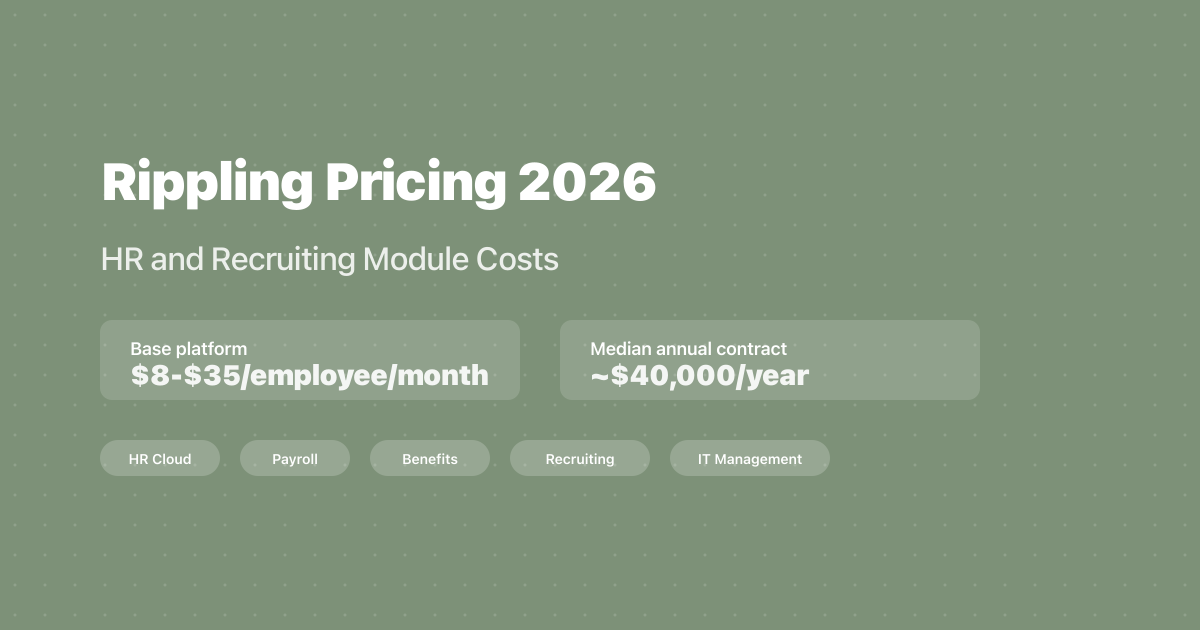
Rippling pricing starts at $8 per employee per month for the base Unity platform, plus a mandatory $35-$40/month flat fee. But that $8 figure is misleading - most companies pay $20-$35 per employee per month once they add the modules they actually need, according to CostBench (2026).
Rippling doesn't publish module-level prices. Every quote is custom, and your total depends on which combination of HR, payroll, benefits, IT, and recruiting modules you select. Rippling HRIS pricing covers the core people-ops layer; payroll, benefits, and IT are each separate add-ons. Based on 235-240 verified purchase records compiled by Vendr (2024-2026), the median annual Rippling contract lands at $39,720-$40,122, with a range stretching from $5,450 to $164,907 per year.
This guide breaks down what each Rippling module costs, shows real-world pricing at different company sizes, explains the recruiting module's limitations, covers hidden fees and contract terms, and compares Rippling to five alternatives. Whether you're getting your first Rippling quote or approaching a renewal, you'll know exactly what to negotiate.
TL;DR: Rippling pricing starts at $8-$35/employee/month depending on modules, with a median annual contract of ~$40K (Vendr, 2024-2026). Rippling payroll pricing adds ~$6/employee/month on top of the Unity base platform. The recruiting add-on costs $150-$300/month for a 50-person team and can't be purchased standalone. Implementation runs $1,000-$5,000 and annual contracts are required.
According to Gloroots (2026) and Business.com (2026), Rippling charges a base platform fee of $35-$40 per month plus $8 per employee per month for Unity - the required foundation that every module sits on. From there, each additional module stacks its own per-employee charge on top.
Here's what Rippling costs monthly at common company sizes, based on the HR + Payroll configuration:

These estimates come from third-party analyst sites - not from Rippling directly. The company requires a custom quote for every deal, and two companies of the same size can pay different rates based on when they signed, what modules they selected, and how hard they negotiated.
A few things to know about Rippling's cost structure:
The gap between Rippling's advertised "$8/employee/month" and what teams actually pay is one of the widest in the HR software market. That $8 figure covers Unity - essentially a database and org chart. The moment you add payroll ($6 PEPM), benefits ($4 PEPM), and IT management ($5-$20 PEPM), your effective rate jumps to $23-$38 per employee. Buyers who anchor on the $8 number during budgeting consistently underestimate their actual spend by 3-4x.
How does that scale annually? Here's the math at three different module configurations for a 100-employee company:
Those figures don't include implementation fees, which add $1,000-$5,000 in year one. And they don't account for the 5-7% annual price escalation that hits at renewal. A three-year total cost of ownership for a 100-person company on the full stack can exceed $140,000 once you factor in escalators and implementation.
Rippling's modular architecture means your total bill - whether you're evaluating Rippling HR pricing, Rippling payroll pricing, or IT management - depends entirely on which products you stack. According to Augtal (2026) and TinyTeam (2026), here's what each module adds to the base platform cost:
| Module | Estimated PEPM Rate | What's Included |
|---|---|---|
| Unity (required base) | $8/employee + $35-$40 flat/mo | Employee database, org chart, time-off policies, SSO, compliance foundation |
| Payroll | ~$6/employee | Automated payroll runs, tax filing, direct deposit, W-2/1099 processing |
| Benefits Administration | ~$4/employee | Medical/dental/vision enrollment, FSA/HSA, open enrollment workflows |
| COBRA Administration | ~$3/employee | COBRA compliance, qualifying event tracking, notification automation |
| Recruiting (ATS) | ~$4/user (buyer-reported) | Job postings, applicant tracking, interview scheduling, offer letters |
| IT / App Management | $5-$20/employee | Identity management, SSO provisioning, app lifecycle management |
| Device Management (MDM) | $8-$12/device | Remote wipe, security enforcement, automated device setup |
Sources: PriceLevel (Q2 2024 buyer data), Augtal (2026), TinyTeam (2026). Rippling does not publish official module pricing.
The most common configurations and their estimated combined PEPM rates:
If you're building a recruiting tech stack, keep in mind that Rippling's approach means you pay for the entire platform even if you only need one or two modules. There's no way to buy just recruiting or just payroll - Unity is always required.
Rippling's recruiting module - also called Rippling Recruiting or Rippling ATS - is an add-on that sits on top of the Unity platform. According to Augtal (2026), the recruiting add-on costs roughly $150-$300/month for a 50-person team, scaling to $400-$600/month for 200 employees. A buyer-reported rate from PriceLevel (Q2 2024) shows $4/user/month for Recruiting Core, though that figure came from a small team and may not reflect standard pricing at scale.
Here's what the recruiting module covers:
What's the actual cost when you factor in the required platform? A 50-person company needs Unity ($8 PEPM + $35 flat = $435/mo) plus the recruiting add-on ($150-$300/mo). That puts the all-in Rippling recruiting cost at roughly $585-$735 per month - before adding HR or payroll modules.
Pin's AI scans 850M+ profiles to find candidates with recruiter-level precision - try it free.
Rippling's ATS handles the basics of tracking applicants. But it wasn't built as a sourcing or outreach platform. Here's what's missing compared to dedicated recruiting tools:
This is the fundamental gap with Rippling's recruiting module: it manages candidates after they enter your pipeline, but it doesn't help you find them in the first place. For teams whose bottleneck is top-of-funnel sourcing and candidate engagement - not just applicant tracking - the Rippling ATS leaves a significant hole that requires a separate tool to fill. That second tool adds cost, complexity, and context-switching to your workflow.
Rippling's strength is consolidation. If you currently run separate systems for HR records, payroll processing, benefits enrollment, and IT provisioning, combining them into one platform eliminates manual data transfers and reduces the chance of errors when an employee joins, changes roles, or leaves. According to Vendr (2024-2026), the most common Rippling buyers are companies in the 50-500 employee range combining HR, payroll, and IT management on a single contract.
Rippling makes sense for companies that:
Rippling is a poor fit for companies that:
Based on procurement data from Vendr (2024-2026) and CostBench (2026), several costs aren't obvious during the initial Rippling sales process. Missing these during negotiation can add thousands to your annual bill.
Rippling charges $1,000-$5,000 for standard implementation, according to CostBench (2026). Gloroots (2026) reports a wider range of $1,500-$20,000 for complex deployments involving global payroll or multiple module configurations. OutSail (2026) estimates implementation at 5-15% of your annual software cost. The good news: implementation fees are often negotiable or waivable, especially at quarter-end.
CostBench (2026) reports that Rippling renewals typically include a 5-7% annual price increase. This isn't always disclosed upfront, and it compounds over a multi-year commitment. A $40,000/year contract in year one becomes $42,800 in year two and $45,796 in year three - an extra $8,596 over three years that isn't in the original quote.
Rippling's quote-based model means there's room to negotiate. Based on 240 verified deals tracked by Vendr (2024-2026), the average buyer negotiates 15% off the list price. Multi-year commitments can unlock 15-25% discounts. Here's what works:

Rippling works well as a unified HR platform for teams that need payroll, benefits, and IT management in one system. But if your primary need is finding and hiring candidates, a dedicated recruiting tool will outperform Rippling's ATS add-on at a lower total cost. According to Vendr (2024-2026), the median Rippling contract is ~$40K/year - here's how alternatives compare for recruiting-focused use cases.
Pin is an AI recruiting assistant that handles sourcing, outreach, and scheduling in one platform. It searches 850M+ candidate profiles with AI-powered matching, runs automated multi-channel outreach across email, LinkedIn, and SMS with a 48% response rate, and schedules interviews without manual back-and-forth. Pricing starts at $100/month (Starter), with Professional at $149/month and Business at $249/month. There's a free tier with no credit card required.
Where Rippling gives you an applicant tracker that waits for candidates to come to you, Pin's AI sourcing actively finds candidates across its database. As recruiter Rich Rosen of Cornerstone Search puts it: "Absolutely money maker for recruiters - in 6 months I can directly attribute over $250K in revenue to Pin." For teams focused on top-of-funnel recruiting rather than back-office HR, Pin delivers at a fraction of Rippling's cost.
Good for small to mid-size teams that need an HRIS with a basic built-in ATS. BambooHR pricing runs $10-$25/employee/month across three tiers, with a $250/month minimum for small teams. The ATS caps active job postings at 5-50 depending on your plan, and there's no candidate sourcing or automated outreach. If your hiring volume is low and you primarily need HR administration, BambooHR covers the basics at a lower PEPM than Rippling.
Good for teams that want a standalone ATS without buying a full HR suite. Workable starts at $299/month flat and includes AI-powered candidate suggestions, automated interview scheduling, and job board distribution. It doesn't bundle payroll or benefits - you buy it specifically for recruiting. At $3,588/year, it's significantly cheaper than Rippling's combined platform + recruiting add-on for teams that don't need HR modules. The downside? Workable's candidate database is limited compared to purpose-built sourcing tools, and outreach automation is minimal.
Good for mid-market teams that prioritize structured hiring processes over speed. Greenhouse starts around $6,000-$6,500/year and offers strong interview scorecards, DEI analytics, and workflow customization. Like Workable, it's a dedicated ATS - no payroll or HR bundled in. The tradeoff is that Greenhouse doesn't include candidate sourcing, so you'll need a separate tool to find candidates. Integration setup can also be time-consuming. Compare it against other options in our applicant tracking system comparison.
Good for enterprises with 500+ employees that need a unified HCM platform. Workday recruiting is bundled inside Workday HCM starting at $100,000+/year, with implementation adding $300K-$800K in year one. It's the most expensive option on this list by a wide margin. Workday makes sense only if your organization has already committed to the Workday ecosystem for finance and HR - otherwise, the cost is difficult to justify purely for recruiting. Implementation timelines of 6-18 months also mean you won't see value quickly.
| Platform | Starting Price | Annual Cost (50 employees) | Candidate Sourcing | Free Tier |
|---|---|---|---|---|
| Pin | $100/mo | $1,200-$2,988 | ✅ 850M+ profiles | ✅ |
| Workable | $299/mo flat | $3,588 | ⚠️ AI suggestions only | ❌ |
| Greenhouse | ~$500/mo | $6,000-$6,500 | ❌ | ❌ |
| BambooHR | $10/employee/mo | $6,000-$15,000 | ❌ | ❌ |
| Rippling (HR + Recruiting) | $8/employee/mo + add-ons | $14,880-$18,480 | ❌ | ❌ |
| Workday | $100K+/yr | $100,000+ | ❌ (add-on) | ❌ |
One of the most common questions buyers ask is whether Rippling can replace a standalone recruiting tool. The short answer: it depends on what "recruiting" means to your team. If recruiting means tracking applicants who apply through job boards, Rippling's ATS covers that. If recruiting means proactively finding candidates, engaging them across channels, and automating the back-and-forth of scheduling, Rippling doesn't do that - and you'll need a second tool anyway.
Here's the total cost comparison for a 50-person company over 12 months:

The Rippling figure assumes HR + recruiting modules only (no payroll or benefits). Adding payroll pushes the total to $26,220-$30,180/year for 50 employees. Add benefits and IT, and you're approaching $40,000+.
For teams that already have an HRIS or payroll system in place, adding Rippling just to get its recruiting module doesn't make financial sense. You'd be paying for redundant HR capabilities. Based on contract data compiled by Vendr (2024-2026), a dedicated recruiting tool that plugs into your existing stack costs 80-90% less than Rippling's combined platform cost while delivering more advanced recruiting features.
Teams that switch from an all-in-one HR platform to a best-of-breed recruiting tool often report faster time-to-fill because they're no longer limited by a generalist ATS. Specialized tools tend to update recruiting-specific features more frequently than platforms that spread development resources across HR, payroll, IT, and finance modules.
Rippling excels at unifying HR, payroll, benefits, and IT management into a single platform. If you need all of those functions and want them to share one employee database, Rippling's modular approach delivers real operational value. The payroll-to-benefits-to-IT automation eliminates manual data entry across systems, and that's a genuine time saver.
But for recruiting specifically? Rippling's ATS is a basic applicant tracker that handles job postings, pipeline management, and interview scheduling. It doesn't source candidates, doesn't automate outreach, and doesn't search external databases. If your team's primary challenge is finding qualified candidates - not managing employee records - you're paying for an entire HR platform to get an ATS that still requires a separate sourcing tool.
The math speaks clearly. A 50-person team using Rippling for HR + recruiting pays $585-$735/month just for the platform and ATS add-on, before even adding payroll or benefits - a figure supported by procurement data from CostBench (2026). A dedicated AI recruiting tool like Pin covers sourcing, outreach, and scheduling for $100-$249/month, with a free tier to start.
Consider these three scenarios:
The right choice depends on what problem you're solving. Need a unified HR operating system with recruiting as one feature among many? Rippling fits. Need to find and hire candidates faster? A purpose-built recruiting tool will outperform Rippling's ATS module and cost less.
Rippling starts at $8/employee/month for the Unity base platform, plus a $35-$40 flat monthly fee. Most companies pay $20-$35 per employee once they add payroll, benefits, and other modules. The median annual contract is $39,720-$40,122 based on 240 verified purchases tracked by Vendr (2024-2026).
No. Rippling Recruiting is an add-on that requires the Unity base platform ($8 PEPM + flat fee). You can't purchase it standalone. For a 50-person team, the recruiting add-on costs an estimated $150-$300/month on top of the required platform fee, according to Augtal (2026).
No. Rippling doesn't offer a free trial or free tier. You can request a demo, but testing the product requires committing to an annual contract. For recruiting specifically, Pin offers a free tier with no credit card required, letting you test AI sourcing before committing to any spend.
Rippling's ATS tracks applicants through a hiring pipeline but doesn't source candidates or automate outreach. Dedicated AI recruiting tools like Pin search 850M+ profiles, run multi-channel outreach sequences with a 48% response rate, and automate interview scheduling - capabilities that aren't available in Rippling's recruiting module at any price tier.
Negotiate at quarter-end for 2-3 free months, push for implementation fee waivers, and request a contractual cap on annual price increases (standard is 5-7%). Multi-year commitments unlock 15-25% discounts according to Vendr (2024-2026). Bringing competitive quotes from BambooHR or Gusto gives your negotiation more weight.